
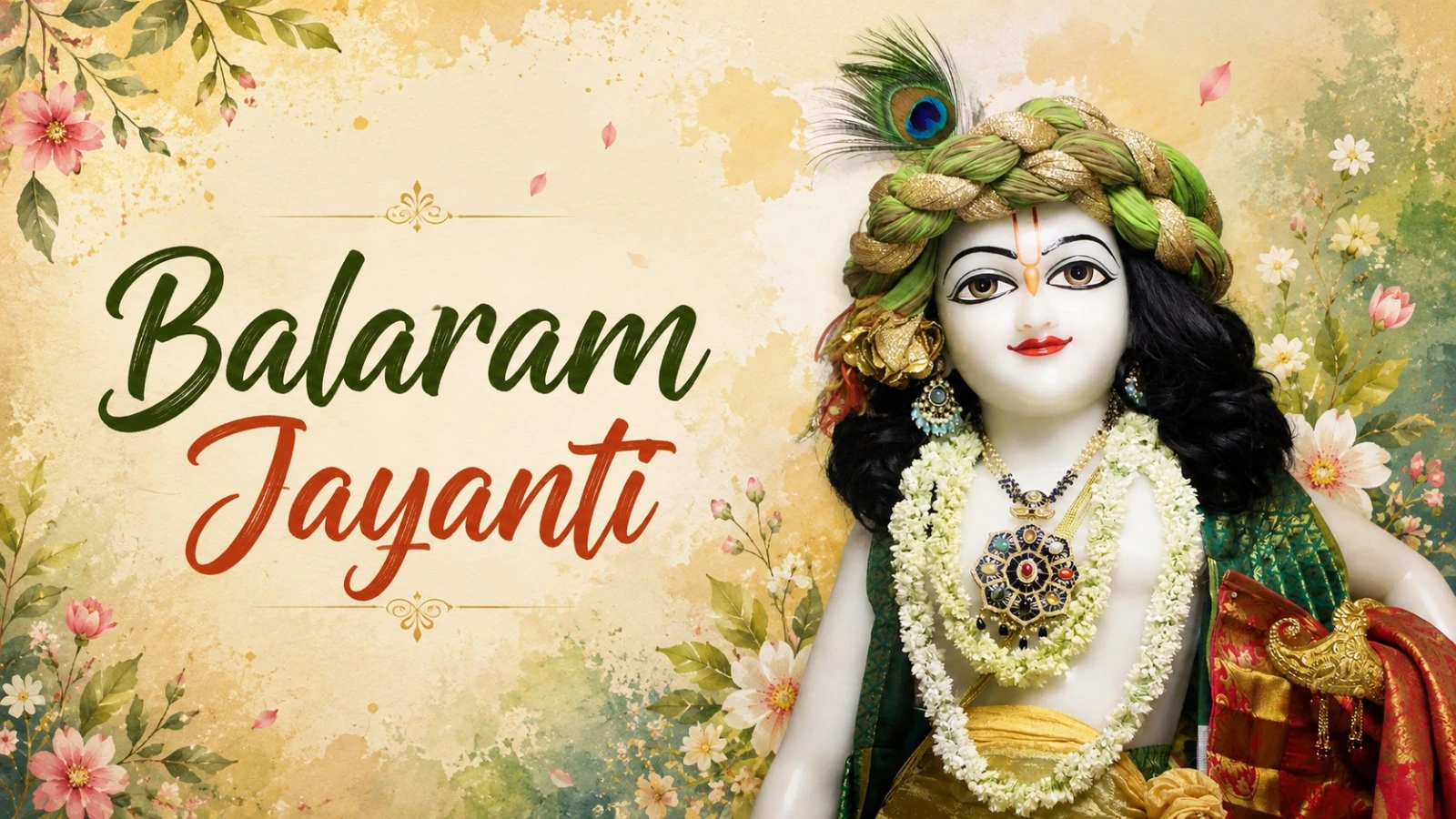
Balaram Jayanti is celebrated as the appearance anniversary of Lord Balaram, the elder brother of Lord Krishna. People in different regions observe Hal Shashti, Baldev Chhath, and Lalahi Chhath and pray to Lord Balaram for the well-being of their family members.
This article covers Lord Balaram’s birth story, the meanings behind His names, His principal pastimes, how the day is observed, and the significance of the related Hal Shashti vrat.
Balaram Jayanti 2026 Date and Timing
In 2026, Balaram Jayanti will be observed on Friday, August 28. The festival is celebrated every year on the full moon (Purnima) day of the month of Shravan. Hal Shashti (Baldev Chhath) falls on Bhadrapada Krishna Shashthi, six days after the full moon (Purnima) of Balaram Jayanti.
| Festival | 2026 Date & Tithi |
|---|---|
| Balaram Jayanti | Friday, 28 August 2026 (Shravana Purnima) |
| Hal Shashti (Baldev Chhath) | Thursday, 3 September 2026 (Bhadrapada Krishna Shashthi) |
Birth and Appearance Story of Lord Balaram
About 5,000 years ago, King Kansa ruled the kingdom of Mathura. A divine voice from the sky foretold that Devaki's eighth son would be the cause of Kansa's death. Fearing this prediction, Kansa imprisoned Devaki and Vasudeva and killed their first six children after birth.
Devaki’s seventh child was transferred from her womb to Rohini’s womb, who was living in Gokul. Kansa was told that Devaki had suffered a miscarriage. In due course, Rohini gave birth to Lord Balaram in Gokul, and this day is celebrated as Lord Balaram’s appearance day.
Soon afterward, Lord Krishna appeared as Devaki's eighth son. Lord Balaram and Lord Krishna were then raised together in Gokul, where they performed many cherished childhood pastimes. Today, devotees across India and around the world celebrate Balaram Jayanti with devotion and faith.
Different Names of Lord Balaram and Their Meanings
| Name | Meaning |
|---|---|
| Balaram | 'Bala' means strength, and 'Rama' refers to one who gives joy—the source of strength and blissful enjoyment. |
| Baladeva | The Lord of Strength |
| Balabhadra | The auspicious, powerful one |
| Haladhara | One who holds the plough |
| Sankarshana | One who attracts or draws—linked to the story of His being drawn or transferred from Devaki's womb to Rohini's womb. |
| Rohini Nandana | Son of Rohini |
| Revati-Ramana | Beloved of Revati—referring to His wife. |
| Sankarshana | The one drawn or transferred from one womb, Devaki's, to another, Rohini's. |
Spiritual Significance of Balaram Jayanti
Balaram Jayanti holds great significance in Indian culture as it commemorates the appearance of Lord Balaram, who symbolizes strength, righteousness, and protection. Anyone who worships Him receives mercy to advance in bhakti and protection from the difficulties of life.
The festival is also closely associated with agricultural prosperity because Lord Balaram is regarded as a deity of farming. For this reason, the occasion holds special significance in agricultural communities.
Famous Pastimes of Lord Balaram
One of the most well-known pastimes of Lord Balaram is His interaction with the River Yamuna. According to the Vedic scriptures, Lord Balaram once wished to bathe in the Yamuna while enjoying time with His companions in Vrindavan. He requested the river to come closer, but when Yamuna did not respond, He used His divine plough (hala) to draw the river toward Him.
Realizing that Lord Balaram possessed extraordinary divine power, the River Yamuna immediately appeared before Him, offered prayers, and begged for His forgiveness. Pleased by her sincere submission, Lord Balaram forgave her and allowed the river to return to her natural course.
What to Offer Lord Balaram on Balaram Jayanti?
Preparations made from milk, butter, ghee, fruits, and dry fruits, such as makhan, kheer, and sweets, can be offered to Lord Balaram on Balaram Jayanti. Lord Balaram is so kind that He accepts any sattvik offering presented with devotion.
Many devotees also prepare homemade dishes, decorate the temple with fresh flowers, and offer seasonal fruits as an expression of gratitude and reverence. The emphasis is not on the richness of the offering but on the purity of heart and devotion with which it is presented.
Religious Importance of Hal Shashti Vrat
Hal Shashthi Vrat holds great religious significance, especially for mothers who observe it to pray for the health, long life, and prosperity of their children. The festival is dedicated to Lord Balaram, who is revered as the deity of strength, agriculture, and protection.
On this day, devotees observe a fast, offer prayers, and seek His blessings for the well-being of their family. The vrat also reminds people to express gratitude toward nature, farming, and the values of hard work and selfless care that Lord Balaram represents.
The vrat follows a distinct set of food rules:
| Typically avoided | Typically allowed |
|---|---|
| Cow's milk and cow milk products | Buffalo milk and its products |
| Ploughed grains (wheat, rice, etc) | Naturally growing foods like sabudana, singhara (water chestnut) |
| Lentils and pulses | Fruits |
| Onion and garlic | Coconut water |
| Vegetables grown by ploughing/cultivation | Naturally available foods not obtained through ploughing |
Balaram Jayanti Seva and Donation
Gau Seva
Lord Balaram spent His childhood in Vrindavan as a cowherd, lovingly caring for and protecting the cows. Since Gau Mata is especially dear to Lord Balaram and Lord Krishna, serving and protecting cows is considered a noble act of devotion. Feeding them fresh green grass or contributing to their care and well-being is believed to invoke the Lord's blessings and mercy.
Annadaan Seva
Lord Balaram is deeply connected with agriculture, and we receive anna, or grains, by ploughing the fields. Therefore, Annadaan Seva is considered especially important on Balaram Jayanti. When one distributes food to hungry people and prays to the Lord, the Lord becomes pleased. Performing Annadaan Seva with devotion pleases Lord Balaram and cultivates humility, compassion, and a spirit of service.
Conclusion
A little devotional service performed on Balaram Jayanti bestows the mercy of Lord Balaram. Donating food to the needy, providing medical care to cows, and offering sincere prayers on this auspicious day are meaningful ways to express one's devotion.
Observing the festival with faith and selfless service helps cultivate gratitude, compassion, and spiritual well-being.
Share this article
Help spread awareness about seva and the power of compassionate service.