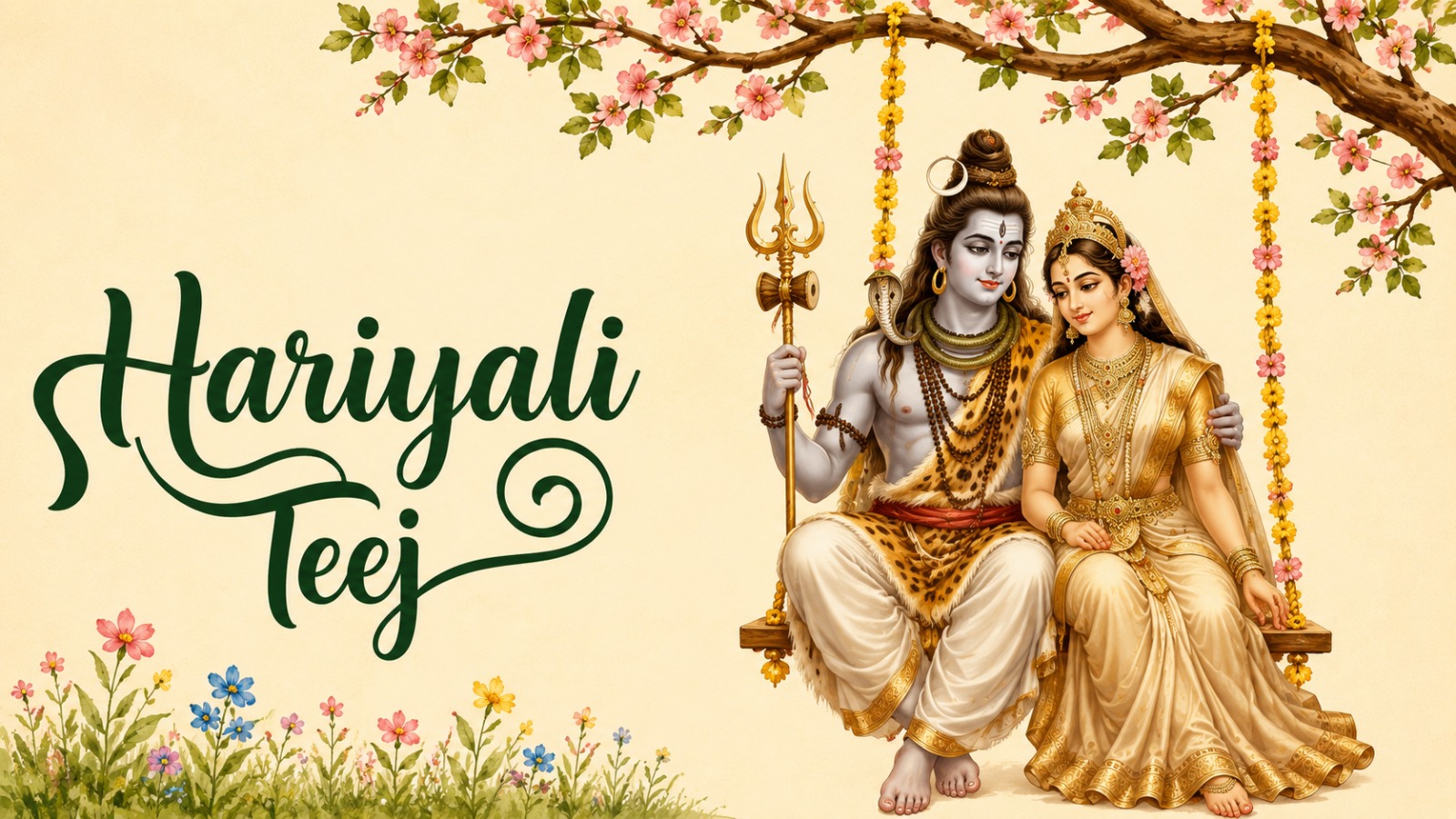
Hariyali Teej is a sacred festival that symbolizes the divine love of Lord Shiva and Goddess Parvati and is celebrated during the season of nature’s lush greenery. The word Hariyali means greenery, while Teej refers to the third lunar day (Tritiya) of the bright fortnight in the month of Shravan, which usually falls between July and August.
Many people assume that Hariyali Teej and Hartalika Teej are the same festival, but they are different. Although both are associated with Lord Shiva and Goddess Parvati, they are observed in different months and follow distinct rituals and traditions.
In this article, you will learn why Hariyali Teej is celebrated, the story behind its observance, and how to perform the puja at home with a complete puja checklist, so you can observe the vrat with devotion and receive the blessings of this auspicious day.
Hariyali Teej 2026 Date
Hariyali Teej will be observed on Saturday, August 15, 2026, on the Tritiya Tithi of Shravan Shukla Paksha.
| DETAIL | INFORMATION |
|---|---|
| Hariyali Teej Date | Saturday, 15 August 2026 |
| Hindu Month | Shravan (Sawan) |
| Tithi | Shukla Paksha Tritiya |
| Hariyali Teej Tithi Begins | 06:46 PM, 14 August 2026 |
| Hariyali Teej Tithi Ends | 05:28 PM, 15 August 2026 |
| Other Names | Sawan Teej, Choti Teej, Green Teej, Madhusrava Teej, Shringar Teej and Shravani Teej. |
| Celebrated By | Married women (mainly), unmarried women in some regions |
| Region | Widely celebrated across North India (Rajasthan, UP, Bihar, MP, Haryana) |
Note: Hariyali Teej Vrat Katha may vary by region due to different sunrise and sunset times, so please cross-check the timings with your local panchang.
What Is Hariyali Teej?
Hariyali Teej is a revered Hindu festival observed during the monsoon season. Celebrated mainly in North India, married women observe a fast and pray to Lord Shiva and Goddess Parvati for the long life and well-being of their husbands. Although it shares some similarities with Karva Chauth, its traditions and observances are distinct.
It is widely believed that on this day, Lord Shiva removes the marital difficulties faced by married women and blesses them with lasting happiness.
Why Is Hariyali Teej Celebrated?
In Sanatan Dharma, Hariyali Teej holds deep significance for both married and unmarried women. Married women observe the fast for the long life and well-being of their husbands, while unmarried women observe the Hariyali Teej vrat to seek a loving and devoted partner, just as Goddess Parvati did.
Beyond these material aspirations, Hariyali Teej also celebrates the abundance of nature. As it falls during the vibrant monsoon season, the festival reflects the earth’s transformation into lush greenery, symbolizing growth, new life, nourishment, and renewal.
On this day, women come together dressed in green attire, sing traditional Teej songs, and apply mehendi to one another’s hands. These customs help strengthen relationships within families and communities.
Hariyali Teej also teaches an important spiritual lesson about unwavering devotion to the Lord. Just as Goddess Parvati never lost hope while performing great penance, this festival reminds us that the Lord always protects and cares for His sincere devotees.
The Story Behind Hariyali Teej (Vrat Katha)
The legendary vrat katha of Hariyali Teej centers on the devotion and faith of Goddess Parvati. According to scriptures such as the Skanda Purana, Shiva Mahapurana, Linga Purana, and Vamana Purana, a girl named Parvati was born in the Himalayan mountains. She was none other than the rebirth of Goddess Sati, the eternal consort of Lord Shiva, who had sacrificed her life during Daksha Prajapati’s yajna. Reborn as Parvati, she believed from childhood that Lord Shiva was her eternal husband and began performing rigorous penance to attain Him.
For many years, she lived in the forest and performed severe devotional austerities. She survived only on leaves, later gave up water, and remained absorbed in worship of the Lord. It is believed that Mata Parvati performed such penance over 108 lifetimes to attain Lord Shiva.
One day, during the bright fortnight of the month of Shravana, Sage Narada approached Lord Shiva and said, “O Neelkanth, Parvati has performed penance for many births and many years to attain You. Please accept her as Your consort.” After hearing Sage Narada’s words, Lord Shiva appeared before Parvati. Deeply pleased by her devotion, faith, and self-control, He accepted her as His wife.
This divine union came to be celebrated as Hariyali Teej, symbolizing Goddess Parvati’s unwavering devotion, faith, and love for the Lord. On this day, devotees decorate swings, nurture nature, and observe the Hariyali Teej vrat. These sacred activities recall the divine pastimes of Shakti and Shiva and inspire devotees to cultivate sincere devotion.
How Is Hariyali Teej Celebrated?
Now that you know the complete vrat katha of Hariyali Teej, it is also important to understand how the festival is observed. If you are wondering what to do on Hariyali Teej, the following rituals have been practiced since ancient times.
Prayers and Fasting Rituals
- Observe Hariyali Teej Vrat: Keep a nirjala fast or a phalahar fast while praying for the long life and happiness of loved ones.
- Worship Lord Shiva and Goddess Parvati: Prepare a clean puja space and place idols or images of Lord Shiva, Goddess Parvati, and Lord Ganesha.
- Offer Puja Items: Offer green bangles, fresh flowers, Bilva leaves, and traditional sweets such as ghewar.
- Recite the Katha: Read the complete Hariyali Teej vrat katha and perform aarti before breaking the fast.
Traditional Adornments and Celebrations
- Wear Green and Red: Dress in a vibrant green or red saree and wear green bangles to reflect the monsoon season and symbolize fertility.
- Apply Mehendi: Decorate the hands and feet with intricate henna designs.
- Enjoy Swings (Jhoola): Gather with family and friends to enjoy decorated outdoor swings hung from trees while singing traditional folk songs and bhajans.
- Exchange Gifts: Share traditional sweets, clothes, and makeup items, often sent by parents to their newly married daughters.
Hariyali Puja Samagri List
Observing Hariyali Puja at home requires some essentials that are needed to perform rituals; check below:
| SAMAGRI ITEM | SIGNIFICANCE |
|---|---|
| Gauri-Shankar Idol/ Picture | A joint idol or picture of Lord Shiva and Goddess Parvati, the main deity worshipped |
| Kalash (Copper/Clay Vessel) | A vessel filled with water, symbolizing purity and auspiciousness |
| Mango Leaves | Used to decorate the Kalash, symbolizing good fortune |
| Roli (KumKum) | Used for tilak and marking puja items |
| Haldi (Turmeric Powder) | Used for purification and as an offering |
| Chandan (Sandalwood Paste) | Applied to the idol/picture, symbolizing peace |
| Diya (Clay Lamp)+ Ghee/Oil | Lit for the aarti, symbolizing light overcoming darkness |
| Agarbatti/Dhoop (Incense) | Purifies the surroundings and creates a sacred atmosphere |
| Fresh Flowers | Offered to the deities during worship |
| Coconut | An auspicious offering (Naivedya) to the deities |
| Red Chunri/Cloth | Offered to Goddess Parvati, symbolizing marital bliss (Suhaag) |
| Mehendi (Henna) | Symbolizes good fortune; applied by married women |
| Bangles (Choodiyan) | Symbolizes Suhaag; also offered to the Goddess |
| Sindoor | Applied by married women after the puja, for the husband's longevity |
| Fruits & Sweets (Naivedya) | Offered as Prasad to the deities |
| Betel Leaves & Nuts (Paan-Supari) | A traditional puja offering |
| New/Green Clothes | Worn on the day of the puja, symbolizing greenery and new life |
| Sindhara Items | A gift hamper sent by parents to their married daughter, a regional custom |
Conclusion
Hariyali Teej is not merely a festive occasion but a sacred day to remember the devotion of devotees toward the Lord. This festival celebrates and strengthens relationships within families and communities through joy, tradition, and devotion.
By observing the Hariyali Teej vrat, singing bhajans, and participating in sacred acts such as Annadaan, Gau Daan, and Sadhu Daan, devotees can celebrate Green Teej with greater faith and devotion. May Lord Shiva and Goddess Parvati shower their mercy upon you and your family on this auspicious Hariyali Teej.
FAQs
Share this article
Help spread awareness about seva and the power of compassionate service.