
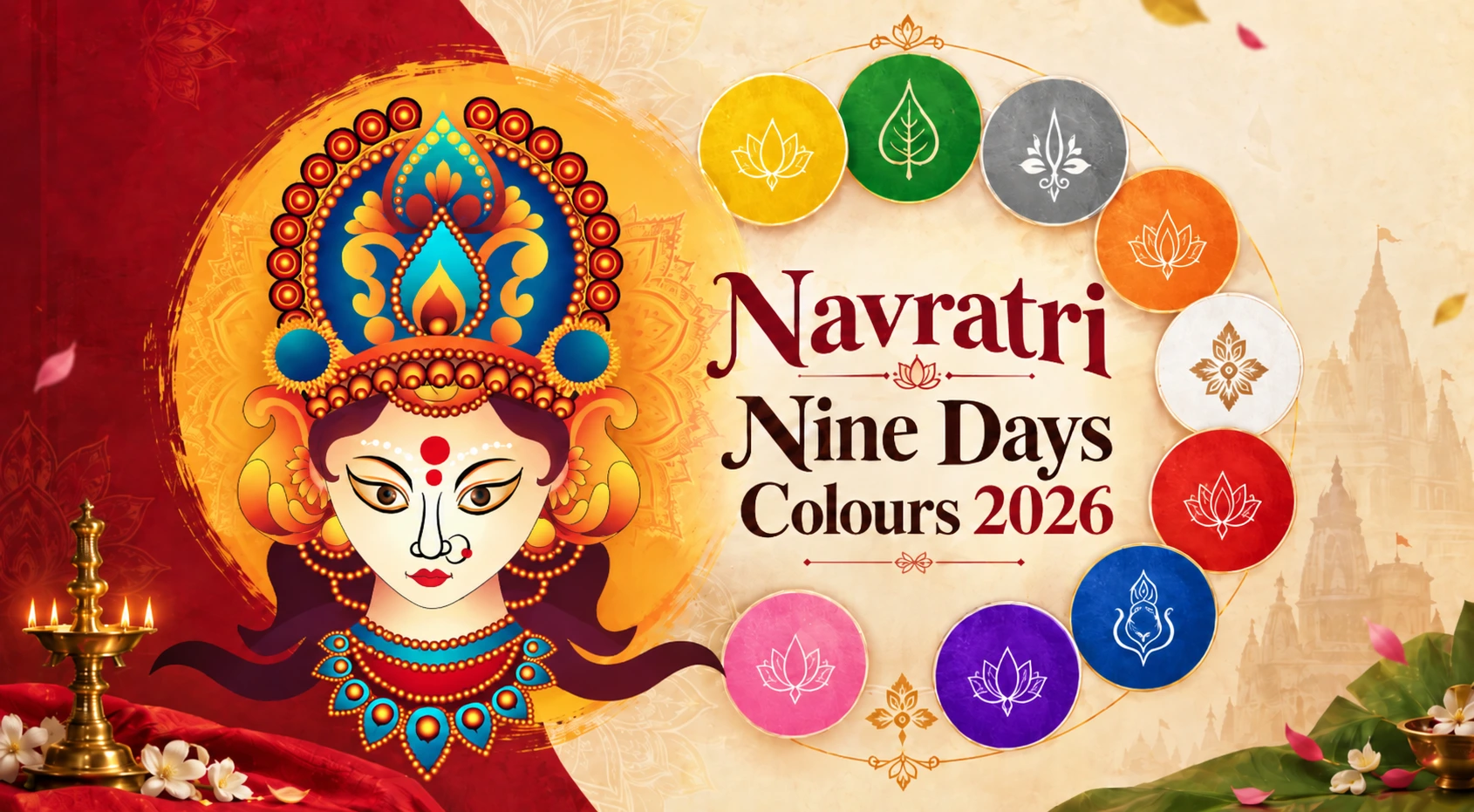
Navratri's nine-day colours reflect different energies and are dedicated to Goddess Durga's 9 avatars. Devotees choose clothes and decorations based on the day's colours to honor each goddess.
The order of colours changes each year, as the festival falls on a different date. Let’s look at the 9 Navratri colours for 2026, their significance, and the Goddess worshipped on each day.
Navratri 9 Colours 2026: Day-Wise List with Dates
Here are the nine Navratri colours for 2026, along with their dates, weekdays, and the Navadurga form worshipped on each day.
| Navratri Day | Date (2026) | Weekday | Colour | Navadurga Form |
|---|---|---|---|---|
| Day 1 | 11 October | Sunday | Orange | Shailputri |
| Day 2 | 12 October | Monday | White | Brahmacharini |
| Day 3 | 13 October | Tuesday | Red | Chandraghanta |
| Day 4 | 14 October | Wednesday | Royal Blue | Kushmanda |
| Day 5 | 15 October | Thursday | Yellow | Skandamata |
| Day 6 | 16 October | Friday | Green | Katyayani |
| Day 7 | 17 October | Saturday | Grey | Kalaratri |
| Day 8 | 18 October | Sunday | Purple | Mahagauri |
| Day 9 | 19 October | Monday | Peacock Green | Siddhidatri |
Please note: The above table follows the Navratri 2026 colour calendar. For puja timings and tithi observance, please check your local panchang. The Ashtami tithi falls on both 18 and 19 October, so the Maha Ashtami puja is observed on 19 October. The colours above follow the day-wise Navratri count. For puja timings and tithi observance, please check your local panchang.
Navratri Nine Days Colours and Their Significance
Now, let’s look at each Nav Durga Colour in detail:
Day 1: Orange
Orange reflects affection, light, and positive energy. This Colour is dedicated to the first day of worship, Goddess Shailputri.
Day 2: White
White represents peace, purity, and simplicity, and is dedicated to the second day worshipped, Goddess Brahmacharini.
Day 3: Red
Red denotes love, emotions, and physical energy, and is dedicated to the 3rd day, Goddess Chandraghanta.
Day 4: Royal Blue
Royal blue denotes depth, richness, and calmness, and is connected with the Goddess worshipped on the fourth day, Maa Kushmanda.
Day 5: Yellow
Yellow Colour denotes brightness and optimism; this colour is associated with the day devoted to Maa Skandamata, the goddess honored on the 5th day of Navratri.
Day 6: Green
Green symbolizes expansion, nature, and new beginnings, and is dedicated to Goddess Katyayani on the 6th day of Navratri.
Day 7: Grey
Grey Colour represents transformation, balance, and a grounded mind and is dedicated to Maa Kalaratri on the 7th day of Navratri.
Day 8: Purple
The Colour purple reflects aspiration, spiritual awakening, and dignity, and is connected with Maa Mahagauri.
Day 9: Peacock Green
Peacock green denotes uniqueness, individuality, and the fulfillment of desires, and is connected to Goddess Siddhidatri.
How are the Colours of the Nine Days in Navratri Decided Every Year?
Navratri nine-day colours are chosen every year depending on the weekday the festival begins on; if the same weekday appears twice in nine days, the Colour will differ for the second occurrence.
So, every year the Nav Durga colours change, but the order of worshipping Goddess remains the same every year.
Why Do Devotees Wear Different Colours During Navratri?
Navratri is a festival full of joyful celebrations, and the Colours of the nine days symbolize devotion, love, faith, and loyalty towards different incarnations of Maa Durga.
Devotees wear different coloured clothes each day to align with the energies of specific Goddesses.
By incorporating and honoring each day's Colour, you can worship Maa Durga without following strict religious practices like fasting.
How to Include Navratri Colours in Your Celebration
Below are some ideas through which you can include Nav Durga colours:
- Clothes and Accessories: If you can't find the exact Colour, a dupatta, thread, or bangles will also work.
- Rangoli and Home Decorations: No need to change the design every day; just add the new Colour in the same design.
- Flowers and Puja Offerings: Before the festival starts, ask your flower vendor to keep 9 different flower Colours for you.
- Puja Thali and Altar Cloth: Keep the thali the same; change the altar cloth daily based on each day’s Colour.
- Gift items and Sweets: Make sweets in Nav Durga colours before the festival itself, so if you are unable to do other things on a given day, you can easily observe the colour tradition with sweets.
Please note that it is not mandatory to buy new things every day; you can also wear and apply resonating Colours; just ensure your devotion is true and pure.
FAQs
Conclusion
The Navratri nine-day colours tradition makes the festival more meaningful, embracing Colourful celebration throughout. From blissful orange to peacock green’s uniqueness, each shade offers devotees a way to nurture and worship each goddess.
Whether you follow colours through clothing, flowers, rangoli, or decorations, let’s celebrate this Sharad Navratri festival with pure devotion.
Share this article
Help spread awareness about seva and the power of compassionate service.