
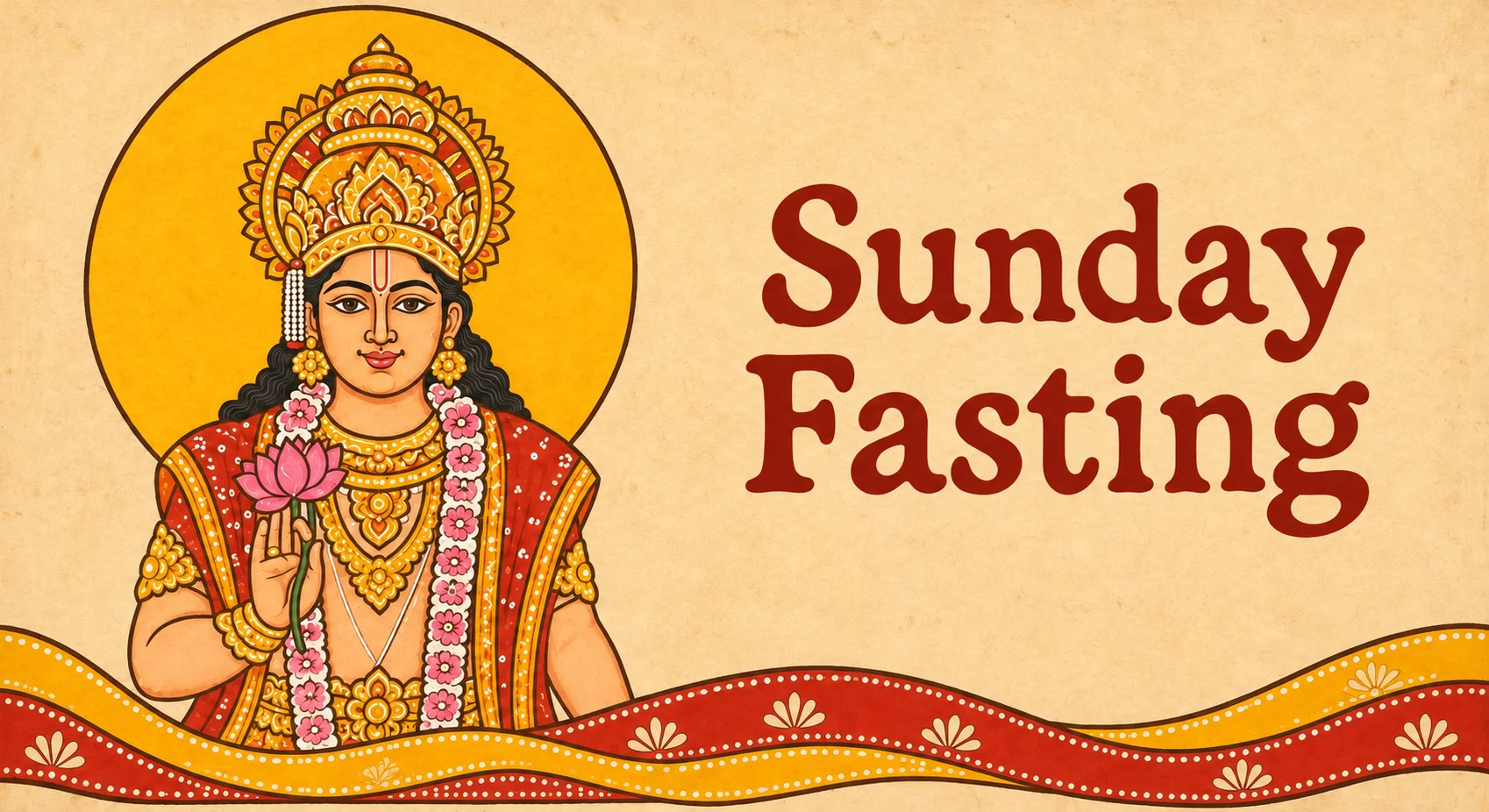
Since ancient times, devotees have observed Sunday fast as an act of heartfelt gratitude to seek the blessings of Surya Dev (the Sun God). Also called Ravivar vrat, it is a weekly observance that is believed to bring light, confidence, energy, good health, and career success in one’s life.
Additionally, it is revered as one of the simplest vrat, with an easy puja vidhi and simple fasting rules.
So, if you are thinking of observing the ravivar vrat, this article explains the significance of the Sunday fast, the fasting rules, the vrat katha in English, and how to break the fast with the correct rituals. Read on and begin your Sunday fast with pure devotion and faith.
Sunday Fast: Meaning and Significance
The Sunday fast is a Hindu vrat kept on Sunday to honor Surya Dev. Called Adityavara in the scriptures, this vrat is well described in the Matsya Purana as Adityavara-vrata-kathanam in twenty verses. It says that observing the ravivar vrat with a sacred vow aligns one’s consciousness with Lord Surya and leads one towards truth and growth.
In the Shiva Purana (Section 1.14), the Sunday fast is described as a spiritual merit that removes all accumulated past and present sins. Its significance lies in nishkama-bhakti (selfless devotion) and the belief that it brings peace and liberation (moksha), as per the Surya Purana.
Moreover, the Rigveda and Aditya Hridayam present the Sunday fast's significance as a faithful observance that reinforces inner discipline and expresses gratitude to the sustainer of all life.
When to Start Sunday Fast
You can observe a Sunday fast anytime, on any Sunday, as there is no fixed date or time period. However, devotees follow different traditions, so the most important thing is to keep the fast with sincerity and clear intention.
Traditions on the best time to start the Sunday Fast:
- Many devotees start it on the first Sunday of Shukla Paksha (the bright fortnight of the moon), in any month.
- Some families believe in keeping it on the first Sunday of Shukla Paksha in Ashwin Month (Between September and October).
- In some regions, Sunday fasting is considered most auspicious in Bhadrapada months (August to September) or in Margashirsha and Magha months (November to December).
- Lastly, if none of these suit your beliefs, start Sunday fasting on any Sunday with pure faith and devotion. Or check with your family traditions once.
Note: Generally, devotees keep a continuous fast for 12 Sundays, while some observe it for 30 Sundays or for a full year. However, it is not mandatory; choose the number as per your capacity, as a fast kept with true intent matters more than how many times you keep it.
Surya Dev Puja Vidhi
Here are the correct and complete Sunday Surya Dev puja steps, which will mark your fast with all rituals and samagri needed:
Surya Dev Puja Samagri List:
- Copper vessel (lota) with clean water
- Red flowers, roli (kumkum), and askhat (uncooked rice)
- Jaggery and wheat for naivedya
- Cow ghee, diya, and a small idol or picture of Surya Dev
- Red Cloth and wooden chowki for the offering seat to the divine
Steps for Surya Dev Puja on Sunday
- 01
Wake up before sunrise and bathe
On the day you observe the ravivar vrat, wake up in Brahma Muhurat, bathe, and add some gangajal to embrace purity. Then wear red clothes or saffron-colored clothes, believed to be very dear to Surya Dev.
- 02
Set up the puja space
Now, clean the puja corner or altar of your house. Place an idol or small picture of Surya Dev facing east, if possible, and spread a red cloth on a wooden seat beside the deity's image. Keep the necessary items ready one day before, so there is no hassle on the day of worship.
- 03
Take the Sankalp
After setting up the altar, sit in front of the idol or picture of Surya Dev, close your eyes, and fold your hands and take a vow in your name with sincerity and devotion. Offer prayers quietly and seek Lord Surya's presence.
- 04
Offer arghya to the rising Sun
This is one of the most important rituals of the Sunday fast. At sunrise, offer red flowers in a copper vessel filled with clean water, along with roli and akshat. Hold it above your head and pour it slowly while chanting mantras like Om Suryaya Namah. If it’s a cloudy day, then offer it in the direction of the sun, and always try to pour the water into a plant on the ground, so no one walks over it.
- 05
Light the lamp and offer bhog
After offering arghya, return to the puja altar and light a lamp filled with pure cow ghee in front of the idol or image of the deity. Also place incense sticks to purify the environment, and offer bhog to the divine, such as seasonal fruits, jaggery, or wheat halwa.
- 06
Listen to Ravivar Vrat Katha
Now, after performing the worship and offering bhog. sit peacefully at the puja altar and listen to or read the Sunday fast vrat katha, understand its meaning, and learn from the sacred story to acknowledge Lord Surya's divinity.
- 07
Perform Aarti and Distribute Prasad
In the evening before sunset, gather all your family members and perform Surya Dev aarti. After the aarti, close your eyes, seek blessings from Lord Surya, and then distribute the prasad among all family members and in the neighborhood.
Sunday Fasting Rules: Food and Common Mistakes to Avoid
Sunday fast includes eating a single meal on the fasting day. But food choices are restricted, as described below, including common mistakes to avoid on the particular day.
Ravivar Vrat: Food to Eat and Avoid
| Category | Foods | Status |
|---|---|---|
| Grains | Wheat roti, daliya, gud-wheat halwa, churma | Eat |
| Sweet | Jaggery (gud), sugar | Eat |
| Dairy | Milk, curd, ghee | Eat |
| Fruits | Seasonal fruits, dry fruits | Eat |
| Drinks | Water, milk, coconut water, fruit juice | Eat |
| Salt | Sendha namak (rock salt) | Eat, and in some traditions regular salt is allowed |
| Pungent Foods | Onion, garlic | Avoid |
| Non-Vegetarian | Meat, fish, egg | Avoid |
| Intoxicants | Alcohol and similar | Avoid |
| Oily and Spicy | Fried food, heavy oil, very spicy dishes | Avoid |
| Processed Foods | Packaged and processed foods | Avoid |
Common Mistakes to avoid while doing Sunday fast:
- Eating or drinking before offering arghya to the Sun
- Waking up late or rushing the morning puja
- Speaking harsh words, speaking in anger, or engaging in negative talk.
- Skipping mantra chanting or katha
- Leaving the fast halfway
- Forcing a hard fast, beyond health capacity
Ravivar Vrat Katha in English
Long ago, an older woman in a village observed the Sunday fast and worshipped Lord Sun every Sunday with pure faith. She was so devoted that every Sunday morning, she woke up early, cleaned her house, and then applied a plaster of cow dung all over the house to purify the space. She didn't even eat anything before offering to Lord Sun.
The old lady had no pain or burden in her life, and she lived well until one day her neighbor locked up her cow so that she couldn't get cow dung for plastering. As the old lady did not have her own cow, she felt very bad, and on that day she didn’t offer food to the Lord, didn't even eat, and slept hungry.
Seeing the old devotee's pain, Surya Dev was pleased the next day. When she woke up, she found a cow and a calf outside her house. She was happy at first, but her neighbor soon became jealous again. The neighbor also noticed that the cow and calf tied in the old lady's courtyard had something special, as their cow dung was gold and was not like a normal cow’s dung.
Out of greed, the neighbor started replacing the gold cow dung with her own cow’s dung. Surya Dev saw this and sent a strong storm. The old lady quickly tied her cow and calf inside the house to keep them safe. The next morning, she was amazed to find gold dung and understood her neighbor’s trick.
Jealous, the neighbor visited the King of the city and told him about the old lady's divine cow. The King ordered his soldiers to get the cow and calf from the old lady. In separation, the old lady did not eat anything and asked Lord Surya for mercy to protect the cows.
That night, the King had a dream in which Lord Surya came and told him to return the cow and calf to the old lady again, or he would face very bad circumstances in the near future. As soon as the king woke up in the morning, he returned the old lady's cow and calf, and more than that, gave her a lot of wealth and apologized for his greed. He also punished the old lady's neighbor for her jealousy and wickedness.
From that day on, the king made it compulsory for everyone living in his kingdom or city to observe the Sunday fast. Since then, the citizens of that city were filled with good health and wealth and started living a peaceful life.
When and How to Break the Sunday Fast
Breaking the Sunday fast is an important part of the fast itself. Usually, devotees follow their family traditions for the timings, so the best way is to break it with a calm mind and offer prayers to Surya Dev.
Best Time to Break the Sunday Fast
As per traditional beliefs, there are three timings followed for breaking the ravivar vrat:
- Before sunset: Many devotees consume their one sattvic meal in the afternoon or before sunset, after the puja.
- After sunset: Some families keep the fast till the day and break it with one simple meal after sunset.
- Next Morning: Stricter observers believe in breaking the fast the next morning after offering arghya to the Sun.
How to Break the Sunday Fast Step by Step
- 01
Complete the Puja First
Finish all the worship rituals before eating anything.
- 02
Offer food to Surya Dev first
Offer food to the Lord first, then consume it.
- 03
Take the first bite as prasad
Eat the first bite of the bhog offered to the Lord as His blessings.
- 04
Eat simple, light sattvic meals
Wheat roti, daliya, gud-wheat halwa, curd, milk, and fruit are good choices. See the food table above.
- 05
End with offering a short prayer
Offer gratitude to Surya Dev and ask him for his mercy and strength.
Breaking the Fast on the Last Sunday
When you complete the vow of keeping Sunday fast for 12, 30, or the whole year, conclude the fast on the last Sunday with Udyapan. After performing all the rituals, feed someone in need, or donate raw food items like wheat, jaggery, copper, and red cloth. This is believed to be a direct offering made to Lord Surya.
FAQs
Conclusion
Observing the Sunday fast and worshipping Lord Surya is an eternal opportunity for all of us to bring good health, wealth, and ultimate energy into our lives. By following the complete puja vidhi and listening to ravivar vrat katha, you can experience both material and spiritual upliftment. Also, no matter which type of fast you keep, focus on maintaining purity in thoughts and actions throughout the day. Share this Sunday fast guide with your family and other devotees, and help them perform the vrat with the correct Sunday fasting rules.
Share this article
Help spread awareness about seva and the power of compassionate service.