
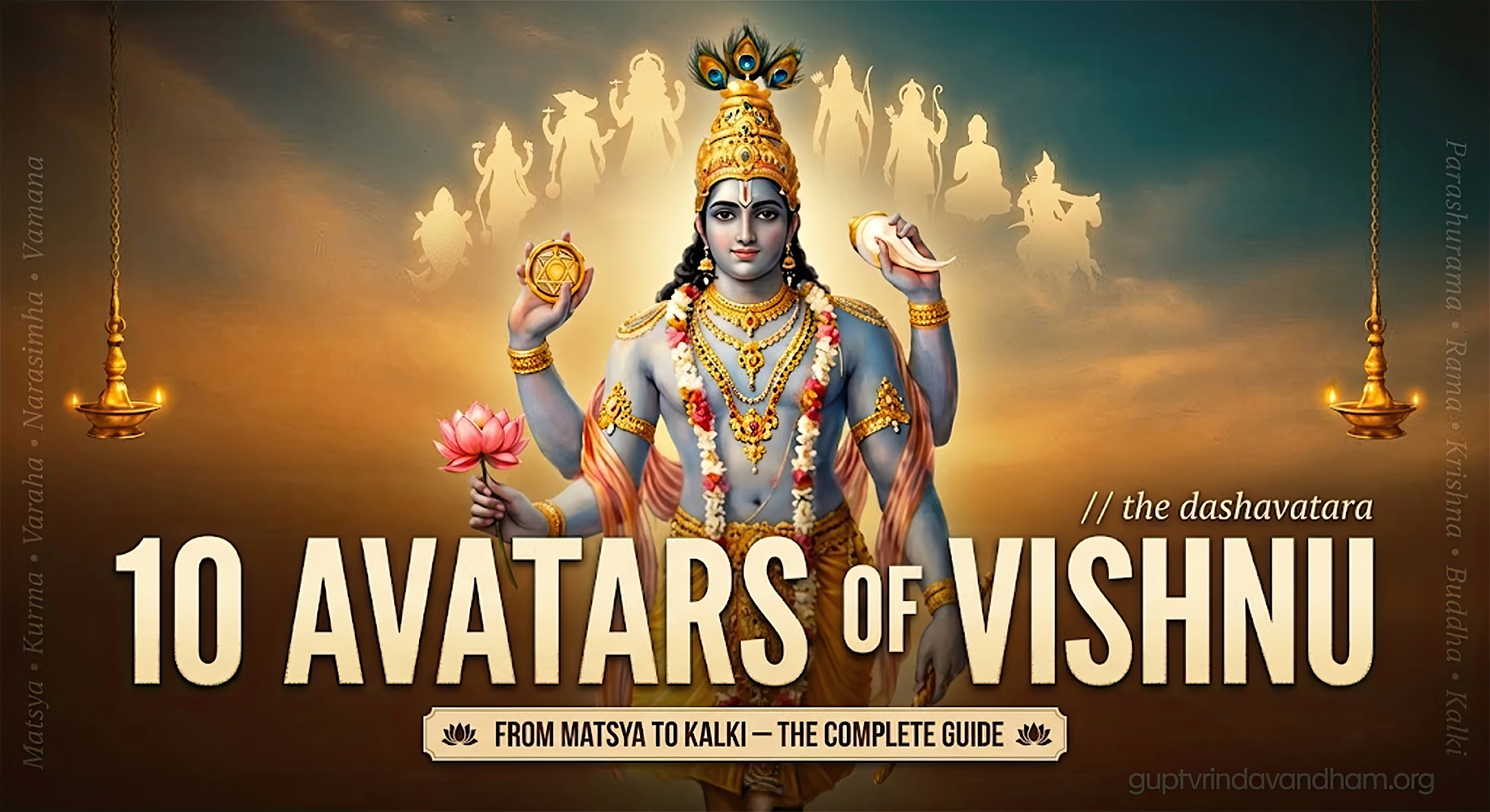
Lord Vishnu is the Supreme Lord in Hinduism and is revered as the preserver of the creation. His 10 avatars, known as the 10 incarnations of Vishnu, are divine forms that have intervened in this world to maintain cosmic order and restore dharma across the different yugas.
These avatars are not only part of the Hindu tradition but are also a true reflection of various aspects of life, offering guidance to humanity.
Lord Krishna himself explains the purpose behind every avatar in the Bhagavad Gita:
“Yada yada hi dharmasya glanir bhavati bharata
Abhyutthanam adharmasya tadatmanam srjamyaham”
“Paritranaya sadhunam vinasaya ca duskrtam
Dharma-samsthapanarthaya sambhavami yuge yuge”
Translation: “Whenever and wherever there is a decline in righteousness, O descendant of Bharata, and a predominant rise of unrighteousness, at that time I manifest Myself.
Let’s look at the Dashavatara of Vishnu in order, along with their roles, so that we can understand the reason and nature behind each incarnation of the Lord.
10 Avatars of Vishnu in Order
The 10 primary avatars of the Supreme Lord, also known as the Dashavatara, represent the evolution of life and human consciousness. Let’s see what role each avatar played orderwise and the reason behind each incarnation:
1. Matsya (मत्स्य) – The Fish Avatar:
The first avatar among the 10 forms of Vishnu is Matsya, which appeared at the beginning of the Satya Yuga (the first stage of the Hindu cosmic cycle). As per the Vedic scriptures, the cycle of the four yugas, i.e., Satya, Treta, Dvapara, and Kali, ranges around 4,320,000.
The Matsya avatar is a giant golden fish that appeared in aquatic form to rescue the sacred Vedas from a demon and protect humanity from the cosmic deluge (Pralay), thereby preserving knowledge and civilization.
STORY:
Once, there was a king named Satyavrata (later known as Vaivasvata Manu), who was meditating by the river, where he found a tiny fish in his water pot. The fish asked the king for protection. Manu helped and kept on transferring it into larger vessels so that it could survive and grow, so that one day it could go into the ocean. However, after some time, Manu realized that the fish was none other than the Supreme deity Lord Vishnu.
The fish revealed that a massive flood was coming and instructed Manu to prepare a massive boat, gather all the Saptarishis, plant seeds, and take one of every animal. Manu made the boat as guided and tied it to Matsya’s Massive horn using the serpent Vasuki as a rope. Meanwhile, Matsya also dived into the deep ocean and slew the demon Hayagriva, who had stolen the Vedas, thereby saving humanity.
2. Kurma (कूर्म) – The Tortoise Avatar
Kurma was the second avatar among the 10 incarnations of Vishnu and is believed to have provided a solid foundation during the legendary churning of the cosmic ocean (Samudra Manthan). His focus was on upholding Mount Mandara, preventing it from sinking while the gods and demons fought to retrieve the nectar of immortality (Amrit).
STORY:
A revered sage, Durvasa, cursed the demigods after Indra insulted them with a garland, and as a result, they were repeatedly defeated by the demons (Asuras). To regain strength, the Devas needed the Amrit, so Lord Vishnu advised the demigods to form a temporary truce with the demons to churn the ocean of Milk. They used Mount Mandara as the churning rod and the serpent Vasuki as the rope. The devas tried hard to lift the heavy mountain, but with no solid base, it kept sinking into the ocean again and again. To save this endeavor, Lord Vishnu appeared as a tortoise and dived to the ocean floor to offer support.
With stable support from the Kurma, the devas and Asuras successfully churned the ocean, yielding the Amrit along with fourteen other divine treasures.
3. Varaha (वराह) – The Boar Avatar
Varaha is the third incarnation among the 10 forms of Vishnu, in which he took the form of a magnificent boar to rescue Mother Earth (Bhudevi) from the depths of the cosmic ocean after she was kidnapped and dragged by the demon Hiranyaksha.
STORY:
The demon Hiranyaksha, blinded by pride and ego, defeated the demigods several times and dragged Bhudevi, one of the three wives of Lord Vishnu, into the primordial waters of the cosmic ocean (Rasatala). At the plea of Brahma and Mother Earth, Lord Vishnu emerged in the form of a wild boar. Varaha dove into the cosmic ocean and located Bhudevi, balancing her on his tusks. After which, the fierce battle between Varaha and Hiranyaksha began and continued for around 1000 years, ending with the demon's slaying. In the end, Varah balanced Bhudevi and carried her back to the surface.
After the fight ended, the earth was restored to its rightful place, Varaha reestablished universal balance, and protected nature and its inhabitants from the pure cruelty and chaos of Hiranyaksha.
4. Narasimha (नरसिंह) – The Man-Lion Avatar
Narasimha, the fourth avatar of Lord Vishnu, is the fierce half-man and half-lion incarnation. He manifested himself to kill the tyrannical demon king Hiranyakashipu, protect his son Prahlada, and restore dharma.
STORY:
Hiranyakashipu was a very powerful and arrogant demon; he performed severe tapasya (penance) to attain an invincible boon from Lord Brahma. He demanded that he could not be killed by any human or animal, neither indoors nor outdoors, neither during the day nor at night, neither on earth nor in the sky, nor by any weapon or instrument. However, despite his constant attacks on his son, Prahlada remained an unwavering devotee of Lord Vishnu. In a fit of rage, Hiranyakashipu himself pointed to a pillar and asked his son. “Is Vishnu everywhere? Is he in this pillar?” Ask him to protect you now.
When he struck the pillar in anger, Lord Vishnu appeared in the fierce form of Narasimha to protect and kill Hiranyakashipu through his claws, which was beyond the boon, as this incarnation of the Lord was neither a human nor an animal, Hiranyakashipu was not on earth or in the sky, and also the timing was of twilight, neither the day nor the night.
5. Vamana (वामन) – The Dwarf Avatar
One of the ten avatars of Lord Vishnu was Vamana, revered as the fifth incarnation and first “human” form. This avatar incarnated to subdue the demon king Mahabali and to restore the authority of the gods in the three worlds.
STORY:
Once upon a time, Mahabali, a demon, was a compassionate, righteous, beloved ruler who attained a boon of power through hard penance, thereby conquering the three worlds Bhuloka (The Earth), Svargaloka (Heaven), and the Pātāla (The Underworld), displacing the king of the gods, Indra. To find help, the demigods asked Lord Vishnu. Vishnu took birth as Vamana, a dwarf Brahmin boy.
Vamana approached Mahabali while the king was performing a grand sacrificial ritual. As per tradition, Mahabali offered to grant the boy whatever he asked for.
Vamana asked for just enough land, which he could cover through his three steps. Mahabali agreed, and Vamana instantly transformed into his cosmic form (Trivikarma). With his first step, he covered the Earth; with his second, he covered the heavens; and with his third, there was no space left. Seeing this, Mahabali offered his own head, and Vamana placed his third step on his head. Pleased by his ultimate humility and devotion, Lord Vishnu granted him immortality and made him the ruler of the underworld, promising that he would be the next Indra in another universe.
6. Parashurama (परशुराम) – The Warrior Sage Avatar
Parashurama is the sixth avatar in the list of 10 incarnations of Lord Vishnu, born to the sage Jamadagni and Renuka. Lord Shiva granted him an invincible axe after performing severe penance. He acted as the ultimate savior of dharma when the kshatriyas became cruel and were oppressing the innocent. Revered as one of the eight Chiranjivi (immortals), Lord Parashuram is believed to be performing penance on Mahendragiri Parvat today as well.
STORY:
Born as Rama (original name) to a Brahmin family, Parashurama developed immense devotion and discipline. As time passed, a king named Kartavirya Arjuna stole Kamadhenu, the divine wish-fulfilling cow, from Parashurama’s father. Provoked by seeing this greed and violence, Lord Parashurama killed the king to retrieve the cow. Seeing this the king's son killed Parashurama’s father.
Witnessing this, Parashurama took a vow to eradicate these corrupt, tyrannical kings 21 times around the world. After attaining this and completing this vow, he gave all the conquered land to the sages and threw his axe into the sea. The water receded, creating the western coast of India (modern-day Kerala, Karnataka, and Maharashtra).
7. Rama (राम) – Prince/King of Ayodhya
The seventh avatar of Lord Vishnu was the embodiment of dharma and the ideal human being, revered as (Maryada Purushottam Ram). He arrived on Earth to destroy the evil Ravana and set the ideal standard of righteous human conduct (dharma) for all of humanity.
STORY:
Born in Ayodhya as the eldest son of King Dashrath and Queen Kaushalya, Rama was the epitome of virtue. Later, after growing up, he married Princess Sita in the Kingdom of Mithila by lifting the famous bow of Lord Shiva. On the day of Lord Rama's Rajya Abhishek, a boon was bestowed by Rani Kaikeyi, forcing him to go into a 14-year exile accompanied by his wife and younger brother Lakshmana in the Dandaka forest.
During the exile, demon Ravana kidnapped Goddess Sita and took her to his kingdom, Lanka. To rescue her, Lord Rama began his search and eventually met Lord Hanuman, the ultimate devotee, who gathered a monkey army to defeat Ravana and rescue Sita Maa.
After defeating Ravana, Lord Rama returned to Ayodhya and was crowned as the King. His reign came to be known as Rama Rajya, and his triumphant return to Ayodhya is celebrated even today as Diwali, bringing prosperity, peace, and ideal governance.
8. Krishna (कृष्ण) – The Divine Statesman
Among the 10 avatars of Lord Vishnu, the eighth is Shri Krishna, who is described as the Purna Avatar, descended to earth to restore Dharma, guide humanity in how to live, and ultimately help them achieve moksha through the spiritual teachings of the Bhagavad Gita.
STORY:
During the Dvapara Yuga, several Kings and rulers, such as Kamsa, became corrupted by demonic pride and arrogance, burdening Mother Earth. During his childhood, Lord Krishna performed many leelas in Braj, loving Gaumata, nature, and his childhood friends like Sudama, Madhumangala, and Subala. Until the age of 11, Lord Krishna lived in Vrindavan, and after that, he had to go to kill King Kamsa and perform the duties for which he was incarnated.
After killing Kamsa, he freed his grandfather, Ugrasena, from prison and restored him as the rightful king of Mathura. Then he took all the Mathura people to Dwarika to establish his new Kingdom. During this time, he played several roles. Then he led the great war of the Mahabharat by guiding his friend, Arjuna, on the battlefield of Kurukshetra and helping him establish righteousness over the wrongdoers.
After performing all the duties, the Lord departed from the earth, leaving his heart behind, which is believed to be preserved within the deity of Lord Jagannath in modern times.
9. Buddha (बुद्ध) – The Enlightened One
Among the 10 different forms of Lord Vishnu, Lord Buddha is seen as the ninth avatar. His purpose was described solely in ancient scriptures such as the Bhagavad Purana, as he was incarnated in the age of Kali to establish dharma through nonviolence and uplift humanity. However, in Vaishnava traditions, Balarama, the elder brother of Lord Krishna, is seen as the ninth avatar of Vishnu.
STORY:
Lord Buddha (Siddhartha Gautama) was born in Kaplivastu (modern-day Nepal). He lived in extreme luxury from his childhood as a prince. However, after witnessing the harsh truth and the cause of suffering, he left his privileges behind. He went to meditate under the bodhi tree, adopting the “Middle Path” between extreme indulgence and severe asceticism.
“While the historical Buddha's life reflects the spirit of compassion and non-violence, the Puranas offer a more symbolic explanation for why Vishnu chose this form:”
According to sacred texts such as the Bhagavad Purana and Skanda Purana, demons became very powerful by following ritual and Vedic principles, making them very hard to defeat. Using this power wrongfully, they threatened demigods, so to restore the cosmic balance, Lord Vishnu appeared as Buddha to deal with the demons by guiding them along a non-Vedic path of preaching.
The avatar convinced the demons to abandon their knowledge and rituals. Once they abandoned their rightful doings, the demigods were able to defeat them and restore dharma.
10. Kalki (कल्कि) – The Future Avatar
Kalki is the tenth avatar and the final avatar among the 10 incarnations of Lord Vishnu in Hinduism. This divine avatar will appear at the end of the Kali Yuga to destroy all negative karmic energies and re-establish dharma.
STORY:
According to ancient Hindu texts, especially the Kalki Purana and the Vishnu Purana, as Kaliyuga progresses, sin, unrighteousness, and ignorance will reach their peak on earth.
He will come on the white horse named Devadatta and will hold a shining divine sword (Axe) in his hand.
Moreover, the primary purpose of the Kalki incarnation of Lord Vishnu is not merely to destroy evil and establish the new holy yuga, the Satya Yuga, the first of the four holy yugas. His arrival will wash away the bad influences on earth and guide humanity again.
Conclusion
From Matsya’s divine help to Kalki's future arrival on a white horse, the 10 avatars of Vishnu are also called the Dashavatara, or 10 avataram, in the South Indian tradition. These avatars reflect timeless wisdom and the ultimate power of the Lord. Each incarnation, however, in a different form and time, carries the same eternal promise Lord Krishna gave in the Bhagavad Gita: whenever righteousness declines, the Lord returns and restores it. Understanding these ten forms is not just learning about the cosmic culture; it is an understanding of the very philosophy that holds the Hindu tradition together.
क्षिप्रं भवति धर्मात्मा शश्वच्छान्तिं निगच्छति।
कौन्तेय प्रतिजानीहि न मे भक्तः प्रणश्यति॥ - Bhagavad Gita 9.31
Translation: He quickly becomes righteous and attains lasting peace. O Arjuna, declare it boldly - my devotee never perishes.
Share this article
Help spread awareness about seva and the power of compassionate service.