
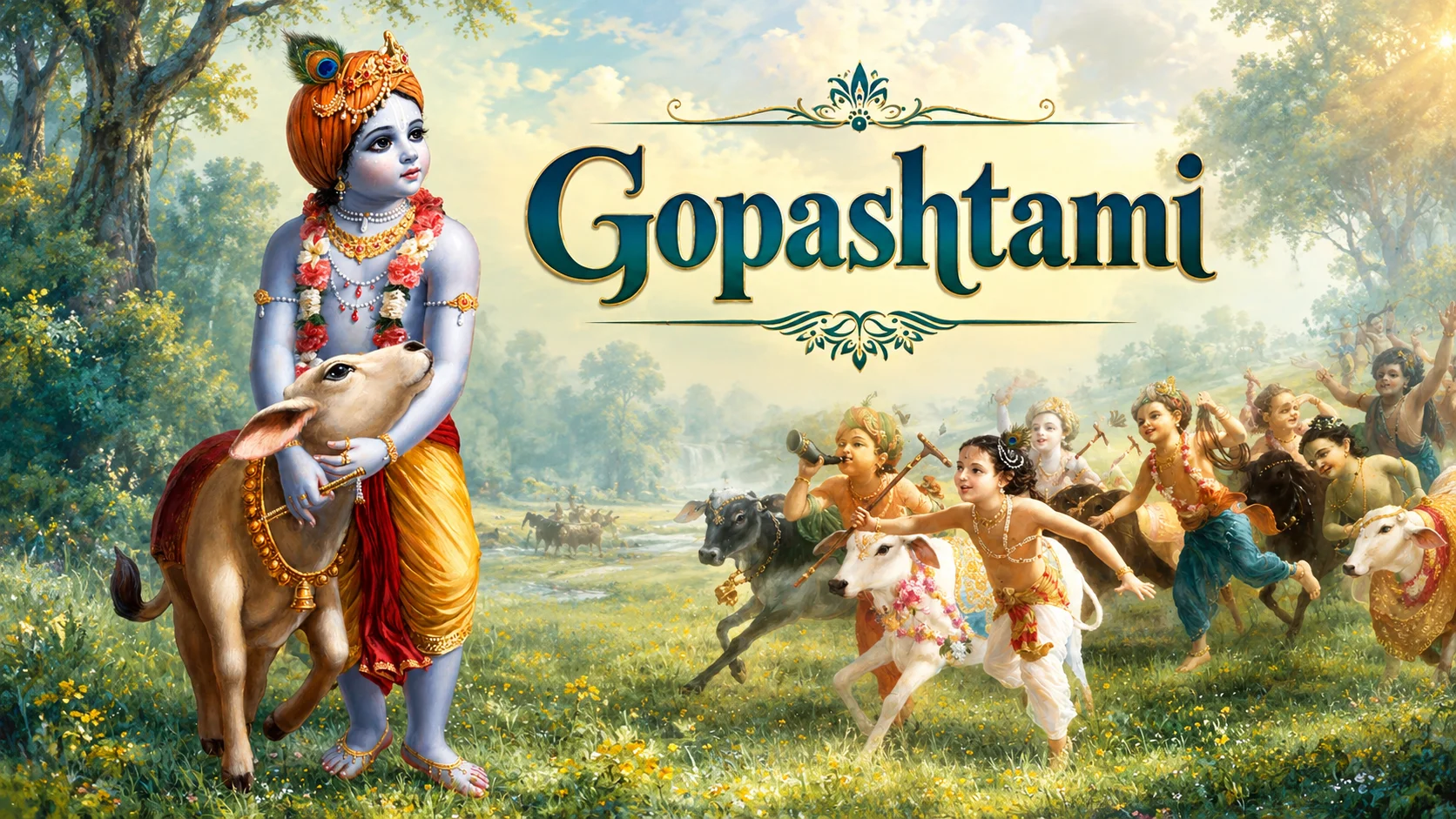
Ever wondered why Lord Krishna is almost always shown with cows? Gopashtami is the festival that answers that question. It celebrates the day young Krishna and His elder brother Balarama were first given charge of the grown cows of Vrindavan. From then on, the Lord became lovingly known as Gopala, the protector of the cows.
In this guide you will find the Gopashtami 2026 date, the story behind the festival, its spiritual significance, a simple step-by-step Gau Puja vidhi you can follow at home or at a gaushala, and meaningful ways to offer Gau Seva on this sacred day.
Gopashtami 2026 Date: Tuesday, 17 November 2026 (Kartik Shukla Ashtami)
Note: Tithi timings vary slightly from city to city, so please check your local panchang for exact timings.
When Is Gopashtami 2026?
As per the Drik Panchang, the Gopashtami festival date and timing for this year is given below:
- Gopashtami 2026 Date: Tuesday, 17 November 2026
- tithi begins: 04:19 AM on Tuesday, November 17, 2026
- Tithi ends: 06:04 AM on Wednesday, November 18, 2026
- Abhijit Muhurat: 11:50 AM to 12:33 PM on Tuesday, November 17, 2026
- Godhuli Muhurat: 05:35 PM to 06:02 PM on Tuesday, November, 17, 2026
Note: Tithi timings and Sunrise timings can differ slightly by a few minutes, depending on the specific region or city, so please check your local panchang.
What to Do on Gopashtami: Step-by-Step Puja Vidhi
- 01
1. Begin with a Bath and Sankalp
Wake up early on 17 November, bathe and wear clean clothes. Clean your home altar, sit before the Lord, and take a simple sankalp (resolution) to spend the day serving Krishna and His cows with devotion.
- 02
2. Worship Lord Krishna and Offer Bhog
Decorate Lord Krishna or Laddu Gopal with flowers. Prepare makhan mishri, kheer or any sattvic dish, place a Tulsi leaf on it, and offer it to the Lord. Light a ghee lamp and offer aarti. Since Gopashtami falls in Kartik, you can also offer a lamp to Lord Damodara as part of your worship.
- 03
3. Chant the Mahamantra and Damodarashtakam
Chant the Hare Krishna Mahamantra with your family:
Hare Krishna Hare Krishna, Krishna Krishna Hare Hare Hare Rama Hare Rama, Rama Rama Hare Hare
You can also sing the Damodarashtakam, the prayer recited throughout the month of Kartik.
- 04
4. Bathe and Decorate the Cows and Calves
If you have cows at home or are visiting a gaushala, gently bathe them with lukewarm water and wipe them with a clean cloth. Decorate them with flower garlands, a cloth, bells or colourful ribbons. Always be gentle, and only bathe or decorate a cow if she is calm. Her comfort comes first.
- 05
5. Perform Gau Puja and Feed the Cows
Apply tilak to the cows and calves, offer flowers and perform aarti. Then feed them fresh green fodder, jaggery and rotis with gratitude. Many families walk a short distance with the cows as they go out to graze, remembering how Krishna led the cows of Vrindavan to the pastures.
- 06
6. Offer Gau Seva to a Gaushala
The most lasting way to mark Gopashtami is to support the cows that need care every day. Gaushalas look after old, sick, injured and abandoned cows that can no longer give milk, and they depend on devotees for fodder, shelter and medical care. On this sacred day you can offer Gopashtami Gau Seva to help feed and care for these cows.
- 07
7. Hear the Pastimes of Krishna as a Cowherd
Spend some time reading or listening to Srimad Bhagavatam, Canto 10, Chapter 15, which describes Krishna and Balarama taking the cows to the forests of Vrindavan. It takes only a few minutes, and children especially love hearing that Krishna knew every cow by name.
- 08
8. Evening Gau Puja and Parikrama at Godhuli Time
In the evening, around sunset, the cows return home. This time is called Godhuli bela ("cow-dust time"). Worship the cows once again, offer them sweets or jaggery, walk around them in parikrama, and touch their feet respectfully to take their blessings. Finally, distribute prasadam to your family and neighbours.
How to Celebrate Gopashtami Without Cows at Home
Most families today live in cities and do not keep cows, but you can still celebrate Gopashtami fully:
- Worship Krishna as Gopala at your home altar with bhog, lamp and kirtan.
- Feed cows in your neighbourhood with green fodder, jaggery or rotis.
- Visit a nearby gaushala or Krishna temple and join the Gau Puja there.
- Offer Gau Seva online. If you cannot visit a gaushala, you can donate for Gau Seva so cows are fed and cared for on your behalf.
- Read Krishna's cowherd pastimes with your children and tell them why Krishna is called Gopala.
Spiritual Significance of Gopashtami
1. Remembering Krishna as Gopala Of Krishna's thousands of names, devotees in Vraja cherish Gopala and Govinda most of all, because both remember His love for the cows. Read more in our list of 108 names of Lord Krishna.
2. Honouring Gau Mata In Sanatan Dharma the cow is called Gau Mata, mother cow. Like a mother, she nourishes the whole family with milk, ghee and curd. Honouring her is an expression of gratitude.
3. Cow protection as dharma In the Bhagavad Gita (18.44), Lord Krishna names cow protection as a natural duty of the farming and trading community: kṛṣi-go-rakṣya-vāṇijyaṁ vaiśya-karma svabhāva-jam ("farming, protecting cows and trade are the natural work of the vaishya"). Krishna Himself grew up in such a family, in the home of Nanda Maharaja.
4. A chance to serve, not just worship Gopashtami reminds us that devotion is shown through service. Feeding, sheltering and caring for cows, especially old, sick or abandoned ones, is service that pleases Krishna directly. Read about the spiritual benefits of feeding cows.
FAQs
Conclusion
Gopashtami is a joyful reminder that the Supreme Lord chose to spend His childhood serving cows in Vrindavan. Worship Krishna as Gopala, honour the cows with Gau Puja, and let your devotion continue through Gau Seva long after the festival ends. Whatever you can offer with love, a handful of fodder, a lamp, or a prayer, pleases the Lord of the cows.
Share this article
Help spread awareness about seva and the power of compassionate service.