
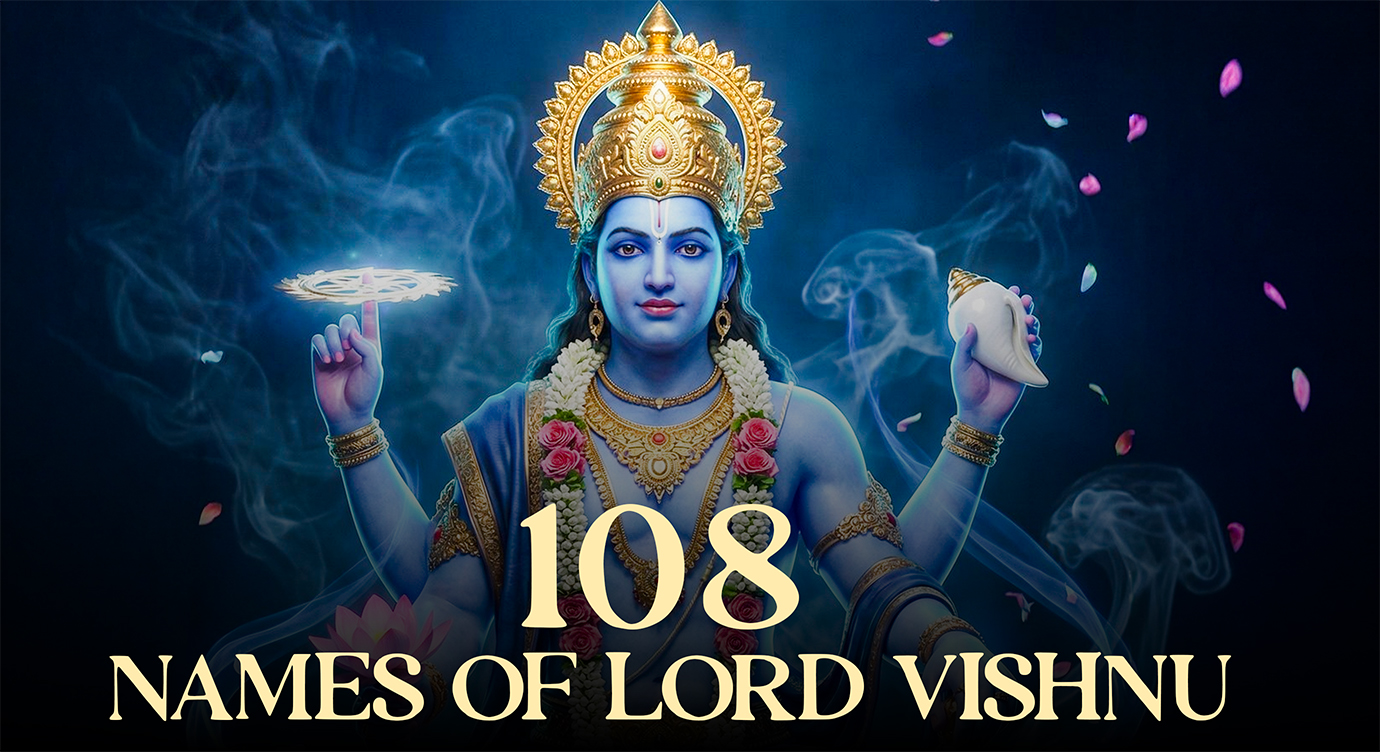
Within the Hindu belief system, Bhagavan Vishnu, also known as Lord Vishnu, is the Supreme Lord who transcends all forms of existence. Worshipping the 108 names of Lord Vishnu brings both spiritual and material benefits, and performing sacred rituals allows one to establish a divine bond with the Lord.
Practising the chanting of the ancient Vedic path allows one to gradually overcome all kinds of challenges in life, cultivate inner wisdom and awareness, and ultimately attain liberation.
The many names of Vishnu extend beyond the scope of cosmic mythology and embody the three eternal spiritual principles of faith, justice, and devotion.
This guide will lead you through the various names of Lord Vishnu (Vishnu Ashtottara Shatanamavali) and elaborate on the religious significance of each holy name, the diverse aspects of Lord Vishnu, and His unconditional love for devotees.
108 Names of Lord Vishnu with Meaning - Complete List
Below is the complete list of 108 names of Bhagwan Vishnu with their meanings:
| English Name | Hindi Name | Meaning |
|---|---|---|
| Vishnu | विष्णु | The preserver and protector |
| Lakshmi Pati | लक्ष्मीपति | Consort of Goddess Lakshmi |
| Krishna | कृष्ण | Incarnation of Vishnu, embodying joy and love |
| Vaikuntha | वैकुण्ठ | One who resides in Vaikuntha |
| Garudadhvaja | गरुडध्वज | One whose vehicle is Garuda |
| Parabrahma | परब्रह्म | The supreme universal consciousness |
| Jagannatha | जगन्नाथ | Lord of the entire universe |
| Vasudeva | वासुदेव | One who resides in all beings |
| Trivikrama | त्रिविक्रम | One who conquered all the three worlds |
| Daityantaka | दैत्यान्तक | Destroys all the demons |
| Madharipu | मधुरिपु | Slayer of the demon Madhu |
| Tarkshyavahana | तार्क्ष्यवाहन | One whose vehicle is Garuda |
| Sanatana | सनातन | The eternal and everlasting Lord |
| Narayana | नारायण | The refuge and shelter of all beings |
| Padmanabha | पद्मनाभ | One with a lotus shape navel |
| Hrishikesha | हृषीकेश | Master of all senses |
| Sudhaprada | सुधाप्रद | Bestower of divine nectar (amrit) |
| Madhava | माधव | The treasurer of all knowledge |
| Pundarikaksha | पुण्डरीकाक्ष | One with lotus-like eyes |
| Sthitikarta | स्थितिकर्ता | One who maintain and protects the cosmic order |
| Paratpara | परात्पर | The greatest of all supreme powers |
| Yajnarupa | यज्ञरूप | One who is the embodiment of yajna |
| Vanamali | वनमाली | One who wears a garland of forest flowers |
| Chakrapani | चक्रपाणि | Bearer of the Sudarshana Chakra |
| Gadadhara | गदाधर | Bearer of the divine mace |
| Upendra | उपेन्द्र | The younger brother of Indra |
| Keshava | केशव | One with beautiful hair or slayer of Keshi |
| Hamsa | हंस | One whose vehicle is swan |
| Samudramathana | समुद्रमथन | One who churned the cosmic ocean |
| Hari | हरि | The master of all nature |
| Govinda | गोविन्द | Protector of cows and all of nature |
| Brahmajanaka | ब्रह्मजनक | The one who created Lord Brahma |
| Kaitabhasuramardana | कैटभासुरमर्दन | Slayer of the demon Kaitabha |
| Sheshashayee | शेषशायी | One who rests on Sheshnaga |
| Shridhara | श्रीधर | One who hold Goddess Lakshmi |
| Kamajanaka | कामजनक | The fulfiller of all desires |
| Chaturbhuja | चतुर्भुज | The four-armed Lord |
| Panchajanyadhara | पाञ्चजन्यधर | Bearer of the Panchjanya conch |
| Shrimat | श्रीमान् | One who is adorned with Goddess Lakshmi |
| Sharngapani | शार्ङ्गपाणि | Bearer of the divine bow, Sharnaga |
| Janardana | जनार्दन | One who compassionately helps all beings |
| Pitambaradhara | पीतांबरधर | One who wears yellow garments |
| Deva | देव | The supreme deity worshipped by all |
| Suryachandravilochana | सूर्यचन्द्रविलोचन | One whose eyes are like the Sun and Moon |
| Matsyarupa | मत्स्यरूप | The divine fish incarnation of Vishnu |
| Kurmatanu | कूर्मतनु | The divine tortoise incarnation of Vishnu |
| Krodarupa | क्रोडरूप | The divine boar (Varaha) incarnation |
| Nrikesari | नृकेसरि | The divine Narasimha incarnation |
| Vamana | वामन | The divine dwarf incarnation of Vishnu |
| Bhargava | भार्गव | Lord Parashurama, an incarnation of Lord Vishnu |
| Rama | राम | Lord Rama incarnation of Vishnu |
| Bali | बली | The supremely powerful one |
| Kalki | कल्कि | The future incarnation at end of Kaliyuga |
| Hayanana | हयानन | The Haygriva incarnation of Vishnu |
| Vishvambhara | विश्वंभर | Sustainer of entire universe |
| Shishumara | शिशुमार | The divine form of Lord Vishnu |
| Shrikara | श्रीकर | Bestower of material and spiritual blessings |
| Kapila | कपिल | The great sage Kapila incarnation |
| Dhruva | ध्रुव | The unchanging and immovable Lord |
| Dattatreya | दत्तात्रेय | The teacher of the entire universe |
| Achyuta | अच्युत | One whose power knows no end |
| Ananta | अनन्त | The infinite and endless Lord |
| Mukunda | मुकुन्द | The bestower of liberation |
| Dadhivamana | दधिवामन | The divine form of Lord Vishnu |
| Dhanvantari | धन्वन्तरि | Divine healer who emerged from the ocean churning |
| Shrinivasa | श्रीनिवास | The eternal abode of Goddess Lakshmi |
| Pradyumna | प्रद्युम्न | The god of love and a form of Vishnu |
| Shrivatsakaustubhadhara | श्रीवत्सकौस्तुभधर | Bearer of the shrivatsa mark and the kaustubha gem |
| Purushottama | पुरुषोत्तम | The greatest among all beings |
| Murarati | मुराराति | Destroyer of the demon Mura |
| Adhokshaja | अधोक्षज | One who is beyond all sensory knowledge |
| Rishabha | ऋषभ | The Rishabha incarnation of Vishnu |
| Mohinirupadharin | मोहिनीरूपधारी | One who took the enchanting Mohini form |
| Sankarshana | सङ्कर्षण | Lord Balarama, an incarnation of Vishnu |
| Prabhu | प्रभु | The source of all creation |
| Kshirabdhishayee | क्षीराब्धिशायी | One who rests on the cosmic milk ocean |
| Bhutatma | भूतात्मा | The soul resides in all living things |
| Aniruddha | अनिरुद्ध | The invincible and unstoppable Lord |
| Bhaktavatsala | भक्तवत्सल | One who loves his devotees deeply |
| Nara | नर | The supreme guide and pathfinder |
| Gajendravarada | गजेन्द्रवरद | One who blessed and saved Gajendra |
| Tridhama | त्रिधाम | One present in all three worlds |
| Bhutabhavana | भूतभावन | Creator and nurturer of all elements |
| Shvetadvipavasatavya | श्वेतद्वीपवास्तव्य | One who resides in Shvetadvipa |
| Suryamandalmadhyaga | सूर्यमण्डलमध्यग | One who resides in the centre of the Sun |
| Sanakadimunidhyeya | सनकादिमुनिध्येय | One meditated upon by sage Sanaka and others |
| Bhagavan | भगवान् | The Supreme Father of the universe |
| Shankarapriya | शङ्करप्रिय | One who is dear to Lord Shankara |
| Nilakanta | नीलकान्त | One with a blue-hued divine radiance |
| Dharakanta | धराकान्त | The nourisher and protector of Earth |
| Vedatma | वेदात्मा | One who is the embodiment of the Vedas |
| Badarayana | बादरायण | Sage Vedavyasa, an incarnation of Vishnu |
| Bhagirathijanmabhumipadapadma | भागीरथीजन्मभूमिपादपद्म | One of the forms from which the river Ganga originated |
| Satam Prabhu | सतां प्रभु | The lord and master of all devotees |
| Svabhu | स्वभु | The self-born sustainer of the world |
| Vibhu | विभु | The all-pervading Lord |
| Ghanashyama | घनश्याम | Lord Krishna, the dark cloud incarnation |
| Jagatkarana | जगत्कारण | The root cause of the entire universe |
| Avyaya | अव्यय | The imperishable and indestructible Lord |
| Buddhavatara | बुद्धावतार | Lord Buddha, an incarnation of Vishnu |
| Shantatma | शान्तात्मा | The supremely peaceful and pure Lord |
| Lilamanushavigrah | लीलामानुषविग्रह | One who takes human form to perform divine leelas |
| Damodara | दामोदर | Lord Krishna, whom Yasoda could not bind |
| Viradrupa | विराड्रूप | Lord Krishna, who revealed his cosmic form |
| Bhutabhavyabhavatprabhu | भूतभव्यभवत्प्रभु | Lord of past, present and future |
| Adideva | आदिदेव | The primordial first god among all gods |
| Devadeva | देवदेव | The God of all gods |
| Prahladaparipala | प्रह्लादपरिपालक | One who protected his devotee, Prahlada |
Why Does Lord Vishnu Have 108 Names? (significance of 108)
Before formally exploring the primary holy names of Hinduism, we must first understand Hinduism’s sacred number 108, which is a prerequisite. This number holds a prominent position in Hindu scriptures and rituals, symbolising the perfection of the universe and divine protection.
Several fascinating facts support this sacred number: for instance, the distance between Earth and the Sun is approximately 108 times the Sun's diameter, and the distance between Earth and the Moon is approximately 108 times the Moon's diameter.
Moreover, the human body contains 108 energy lines that converge to form the life-giving heart chakra. So, chanting Lord Vishnu's names 108 times can create resonance, connect you to universal energy, and bring about a spiritual transformation that transcends this materialistic world.
Also, the 108 names of Lord Vishnu are collectively called the Vishnu Ashtottara Shatanamavali, where Ashtottara means 108, and Namavali means a garland of names. Together, these names of Lord Vishnu provide a spiritual portrait of the Lord in his different incarnations, powers, and his eternal presence in the universe.
Benefits of Chanting 108 Names of Lord Vishnu
- 01
Eliminates Negativity
Chanting the holy names of Lord Vishnu helps in removing negativity from the chanter's life. The reciter’s mind cleanses all the curses and sins that have fallen upon him and eradicates all evil actions like lust, greed, and jealousy that can destroy him. The vibration chanting acts as a protective barrier, and the chanter feels protected and connected with the Supreme Lord’s energy.
- 02
Attracts Abundance, Positivity, and Wealth
When a devotee chants the Vishnu Ashtottara Shatanamavali with utmost faith, they receive the divine blessings and attract positive qualities such as wealth, success, pleasure, good reputation, and inner happiness. The Supreme Lord Vishnu offers them confidence and energy that are beyond the material world.
- 03
Freedom From Diseases
Chanting the 108 names of Lord Vishnu has the power to eradicate illness by cleansing the surroundings. A sick individual can also overcome their illness and attain great mental stability, which allows us humans to achieve good health and a pure mind, practice devotion, and live a healthy life.
- 04
Cultivates Humility and Gratitude
Reciting different names of Bhagwaan Vishnu helps one remain grounded and attached to the core values of Dharma. The devotee can purely acknowledge and accept that the Lord is the supreme universal power and no human or creature is above him.
- 05
Offers Liberation
By chanting Lord Vishnu's other names, one can attain moksha from this materialistic world and can even break the cycle of birth and death. The chanting helps overcome all the sins and past karmic debts.
How to Chant Vishnu Ashtottaram - Step by Step
- 01
Time and Space
Chant during Brahma Muhurat between 4 AM and 6 AM or during evening time in a quiet, peaceful corner facing East or North.
- 02
Purification and Altar
Take a holy bath, wear yellow clothes, sit on a clean mat and light a ghee diya before a picture of Lord Vishnu with Tulsi leaves.
- 03
Posture and Mala
Sit straight and hold a Tulsi Mala in your right hand, moving the Japa beads with your thumb and middle finger only. One round is equivalent to the chanting of 108 names.
- 04
Chanting Technique
Pronounce each of the 108 names of Vishnu with meaning clearly, starting with “Om” and ending with “Namah” without rushing.
FAQs
Conclusion
The 108 names of Lord Vishnu are not just words - they are a sacred bridge between the devotee and the divine. For thousands of years, these names have guided devotees to attain peace, abundance, and liberation.
Whether you are chanting it for the first time or are a practitioner with years of practical experience, Lord Vishnu’s grace remains constant and unconditional for everyone. These sacred names not only cover the attributes of his many cosmic avatars, but also reflect the divine traits that define him as the supreme protector of the universe.
Each holy name is an offering in itself, and every recitation is a prayer. Incorporating this recitation into daily life allows one to gain spiritual growth, inner peace, and divine protection. This practice is far from a mere religious activity; it is a way of living a devotional life.
Jai Shri Hari!
Support Annadaan Seva through Adhyatmik Seva
Your offering helps serve fresh, sattvic meals to those in need and turns your contribution into a sacred act of compassion.
Share this article
Help spread awareness about seva and the power of compassionate service.